Recently, a research team from Jilin University’s International Center of Future Science, the College of Chemistry, and the State Key Laboratory of Inorganic Synthesis & Preparative Chemistry published their work. “Zeolites as Photoactive Scaffolds for Efficient Photooxidation”in Journal of the American Chemical Society.
This research reports a highly efficient composite photocatalyst, CABB@ZSM-5, which is based on zeolite ZSM-5 encapsulating perovskite nanocrystals (Cs2AgBiBr6, CABB). It is designed for the selective oxidation of toluene to benzaldehyde under visible light irradiation. This research reports a highly efficient composite photocatalyst, CABB@ZSM-5, which is based on zeolite ZSM-5 encapsulating perovskite nanocrystals (Cs2AgBiBr6, CABB). It is designed for the selective oxidation of toluene to benzaldehyde under visible light irradiation. Doping with Zn2+ further boosted the benzaldehyde yield by twofold, while the catalyst maintained excellent stability.
Zeolites, recognized for their well-defined pore structures, unique framework topologies, and tunable acidity, are widely used as efficient heterogeneous catalysts, adsorbents, and ion exchangers, playing a vital role across numerous industrial and environmental sectors. However, their inherent insulating nature poses a significant challenge for photocatalytic applications. The insulating framework struggles to facilitate the efficient transfer and separation of photogenerated charges, thereby limiting its capacity to drive oxidation and reduction reactions on the catalyst surface.
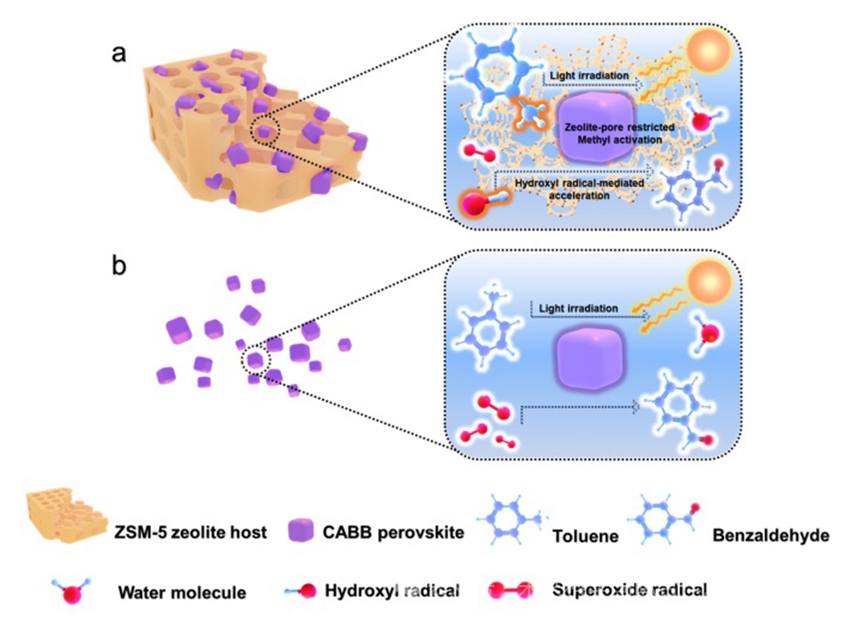
To address this challenge, this study innovatively utilizes zeolite as a photoactive host for supporting perovskite nanocrystals, successfully triggering a hydroxyl radical (•OH)-mediated pathway for selective C(sp3)–H bond activation. Via a host-guest assembly strategy, Cs2AgBiBr6(CABB) nanocrystals were confined within the ZSM-5 zeolite matrix, enabling highly efficient and selective oxidation of toluene to benzaldehyde. Notably, mechanistic studies reveal that the traditionally considered non-photoactive zeolite host can promote toluene oxidation by generating hydroxyl radicals (•OH) under visible light irradiation, which is a key step in the reaction. The resulting CABB@ZSM-5 catalyst efficiently converts toluene to benzaldehyde under ambient conditions and visible light, achieving a selectivity exceeding 98% and a production rate of 40.9 mmol·g-1·h-1. This rate is approximately 41 times higher than that of bulk-CABB (1.0 mmol·g-1·h-1) and ranks among the highest performances reported recently in photocatalysis. Comprehensive spectroscopic analysis indicates that the interaction between the CABB guest and the ZSM-5 host significantly enhances the composite's ability to adsorb and activate both oxygen and toluene molecules. The study further found that water molecules adsorbed within the zeolite channels help drive the •OH-mediated reaction pathway, which is thermodynamically more favorable compared to the conventional superoxide radical (•O2⁻) pathway. Furthermore, introducing Zn²⁺ into CABB@ZSM-5 could further boost the benzaldehyde production efficiency. This work not only uncovers the crucial role of typically non-photoactive zeolite hosts in photocatalysis but also highlights the vast potential of zeolite-based host-guest catalyst design, providing new insights for developing sustainable chemical transformation technologies.
https://pubs.acs.org/doi/10.1021/jacs.5c13535