On December 19, 2025, a research team led by Prof. Cai Dawei from the Bioarchaeology Laboratory and the School of Archeology of Jilin University, in collaboration with Prof. Choongwon Jeong's team from Seoul National University, ROK and numerous domestic archaeological research institutions, published a research paper titled “Ancient genomes illuminate the origins and dynamic history of East Asian cattle” in the international academic journal Science. This study, for the first time, systematically constructed a complete genetic map of the origin and migration of east Asian cattle. Providing a new perspective for exploring prehistoric cross-continental human migration, technology transfer, and exchanges amongst ancient civilizations. This also marks the first time that Jilin University, as the first author's affiliated institution, has published research findings in Science in the field of philosophy and social sciences, signifying a breakthrough in the university's bioarchaeology research.
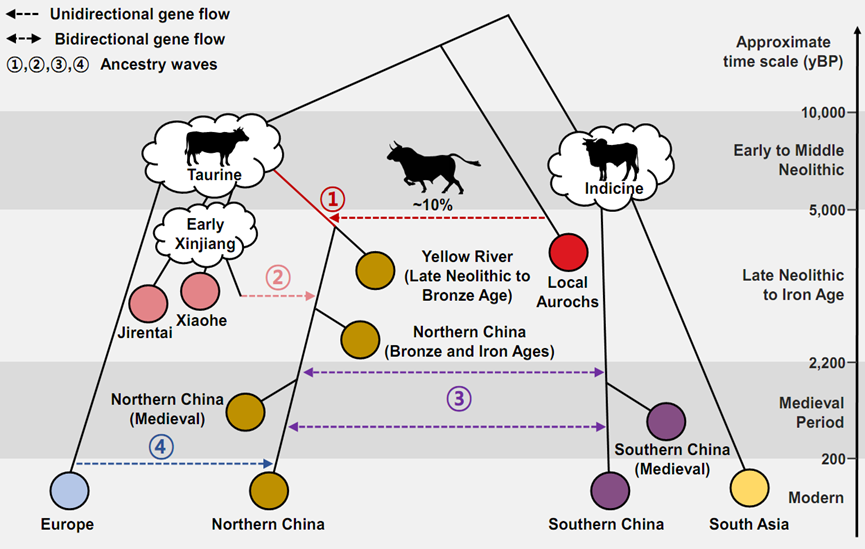
The research team integrated 166 ancient bovine samples from dozens of archaeological sites across China, covering a time span of nearly ten thousand years, and constructed the world's largest complete data set of ancient cattle genomes in East Asia to date. The study challenges the traditional view of a “single origin” of east Asian cattle, revealing their formation was a gradual process involving multiple external introductions and deep integration with local populations.
This research significantly deepens the international academic community's scientific understanding of the origin, domestication, and dispersal of east Asian cattle while also highlighting the extensive and profound historical interactions between Chinese civilization and neighboring regions during its formation and development. It opens new scientific perspectives for exploring economic foundation transformations, societal complexity processes, and cross-regional civilizational exchanges, while also providing important academic support for interpreting the historical foundations of “community with a shared future for mankind”.
The primary completing institution for this research is the Bioarchaeology Laboratory of Jilin University. Prof. Cai Dawei is the first author and corresponding author of the study. Dr. Donghee Kim from Seoul National University, ROK is a co-first author, and Prof. Choongwon Jeong is a co-corresponding author. This study was supported by the National Social Science Fund.
In recent years, the university has consistently prioritized the high-quality development of philosophy and social sciences, fostering a new model that integrates discipline construction, platform development, and talent cultivation. As one of the first pilot institutions for philosophy and social sciences laboratories under the Ministry of Education, Jilin University’s Bioarchaeology Laboratory has focused on advancing disciplinary frontiers, breaking traditional boundaries, and effectively integrating resources from archaeology, biology, medicine, chemistry, earth sciences, history, and other fields, laying a solid foundation for major original achievements.
Article Link: https://www.science.org/doi/10.1126/science.adu9904