Jilin University (JLU) and the Beijing Institute of Applied Physics and Computational Mathematics (Beijing IAPCM) published an article in Physical Review Letters on Sept 13, demonstrating their progress in achieving high spatiotemporal resolution tomography of complex gas-phase molecules.
The first author is doctoral candidate YANG Yizhang from JLU’s Institute of Atoms and Molecular Physics, while Associate Researcher HU Xiaoqing from the Beijing institute and WU Lu from JLU’s institute serve as co-first authors.
Professors DING Dajun and WANG Chuncheng from JLU’s institute and Researcher WU Yong from the Beijing institute are the corresponding authors.
According to the article, the fast evolution law of the transient structure of molecules is related closely to processes such as charge and energy transfer, and is a frontier topic in attosecond physics and femtosecond chemistry. However, there is currently no method to achieve high spatiotemporal resolution tomography of complex gas-phase molecules.
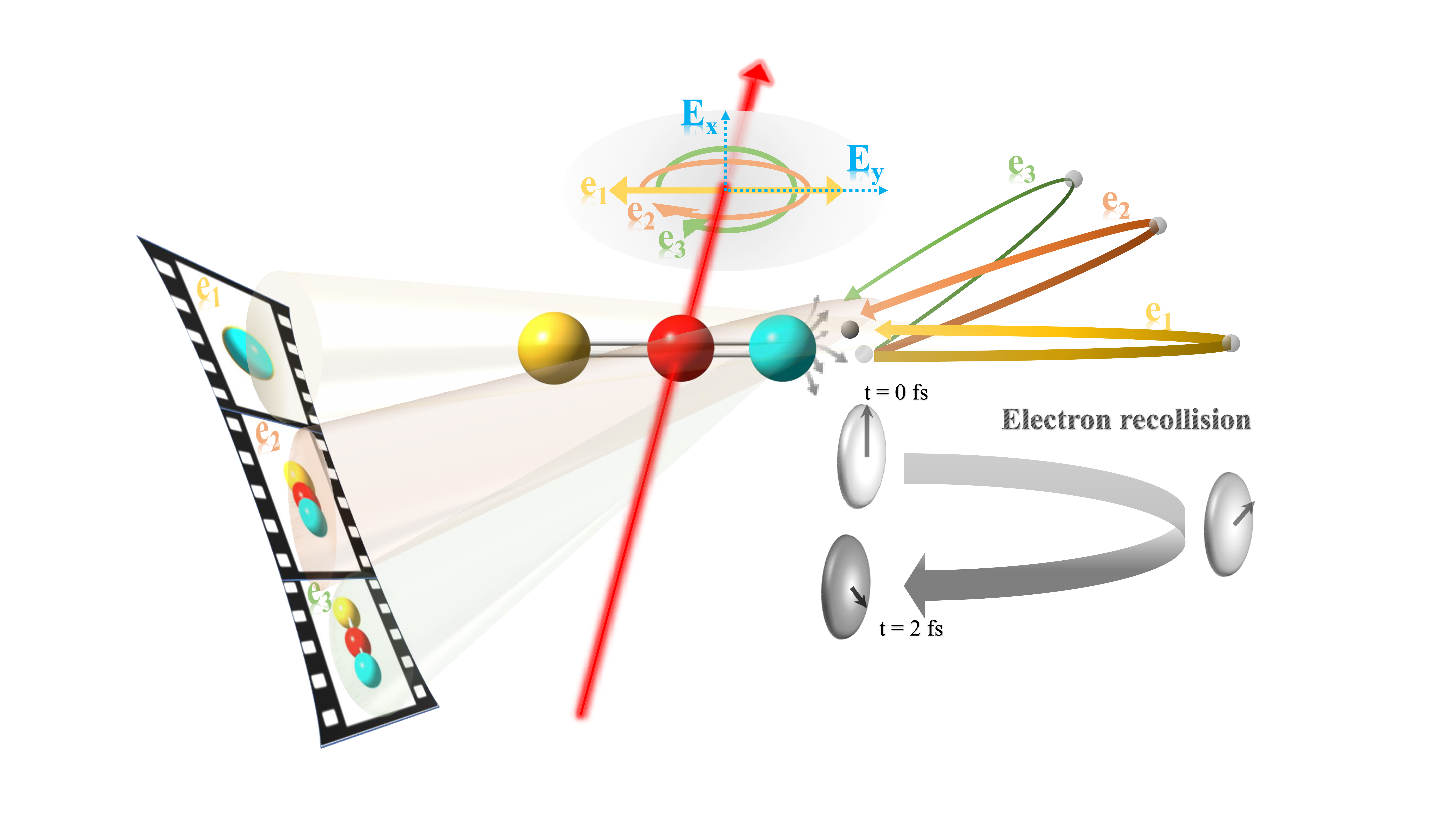
To solve this issue, JLU’s research team worked closely with the teams from Beijing IAPCM and University of Science and Technology of China. They proposed the elliptical laser-induced electron diffraction (ELIED) self-imaging technology, achieving high-temporal-spatial-resolution precise tomographic imaging of transient structures of gas-phase molecular ions.
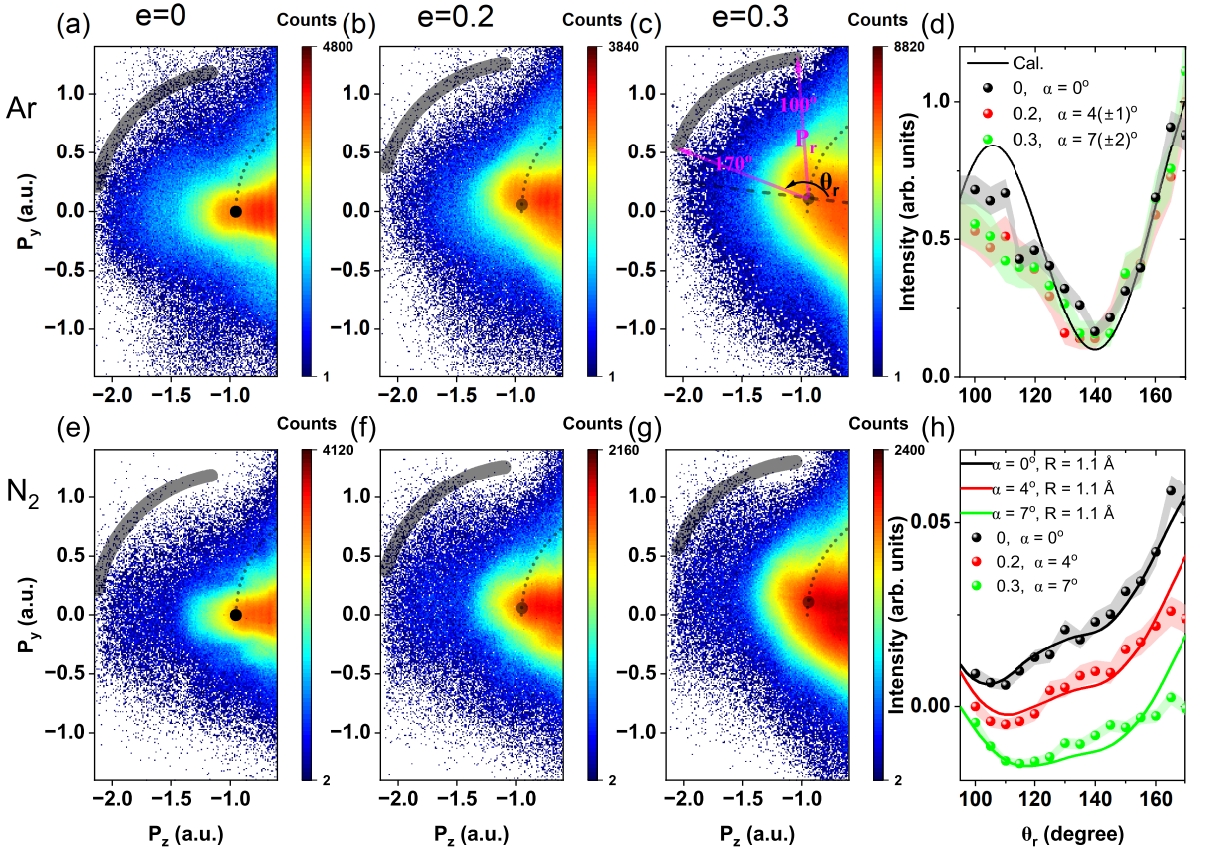
The ELIED technology offers a novel approach to examining intricate electron dynamics processes, including high-order harmonic generation and high-order threshold ionization driven by elliptical laser pulses.
Furthermore, this technology can be applied to uncover the ultrafast non-adiabatic relaxation mechanism of molecular excited states and frontier topics such as molecular chiral recognition.