Professor HUANG Xiaoli from the College of Physics at Jilin University (JLU), in collaboration with international partners, published groundbreaking findings in the journal Nature on Feb 28, 2024.
The research is titled Imaging the Meissner effect in hydride superconductors using quantum sensors.
The first authors are Pra Bhattacharyya from the University of California, Berkeley (UC Berkeley) and CHEN Wuhao and HUANG from the State Key Laboratory of Superhard Materials at JLU. The corresponding author is Professor Norman YAO from UC Berkeley.
The research team made a groundbreaking discovery in the study of superconductivity in superhydride under high pressure. Using diamond nitrogen-vacancy (NV) center quantum sensing technology, they successfully measured the Meissner effect in superhydride under extreme pressure conditions.
Superconductivity, particularly the pursuit of room-temperature superconductors, has long been a scientific goal. Professor HUANG’s team previously identified several novel superhydrides using various high-pressure techniques. However, the authenticity of these hydride superconductors was later questioned.
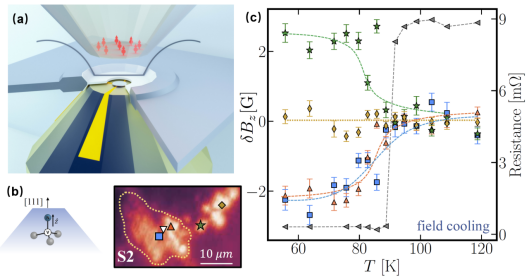
In collaboration with Professor YAO’s team, HUANG applied the highly sensitive NV center sensing technology to study superconductivity in hydrides under ultra-high pressure.
This approach allowed them to simultaneously measure the zero resistance and the Meissner effect of cerium hydride samples under the same pressure conditions.
The research also performed high-sensitivity magnetometry with spatial resolution at pressures exceeding 1 million atmospheres, opening new avenues for studying magnetic properties in extreme environments.